Battery storage entered MISO's interconnection queue as a footnote before 2020. By 2024, it had become one of the fastest-growing application categories in a market that still operates the largest installed wind capacity of any US ISO. The LBNL "Queued Up" 2024 report documents the national trend; MISO's version of it has distinctive regional characteristics driven by state RPS requirements, IRA incentives, and the wholesale market mechanics of a footprint that spans 15 states from Manitoba to Louisiana.
Load Factor tracks 5,545 active projects in MISO's queue. The storage surge is visible across multiple states, but the geography and developer profile differ from what ERCOT or CAISO have experienced. Understanding why MISO's storage boom is happening — and who is building it — requires looking at both the economics and the regulatory context.
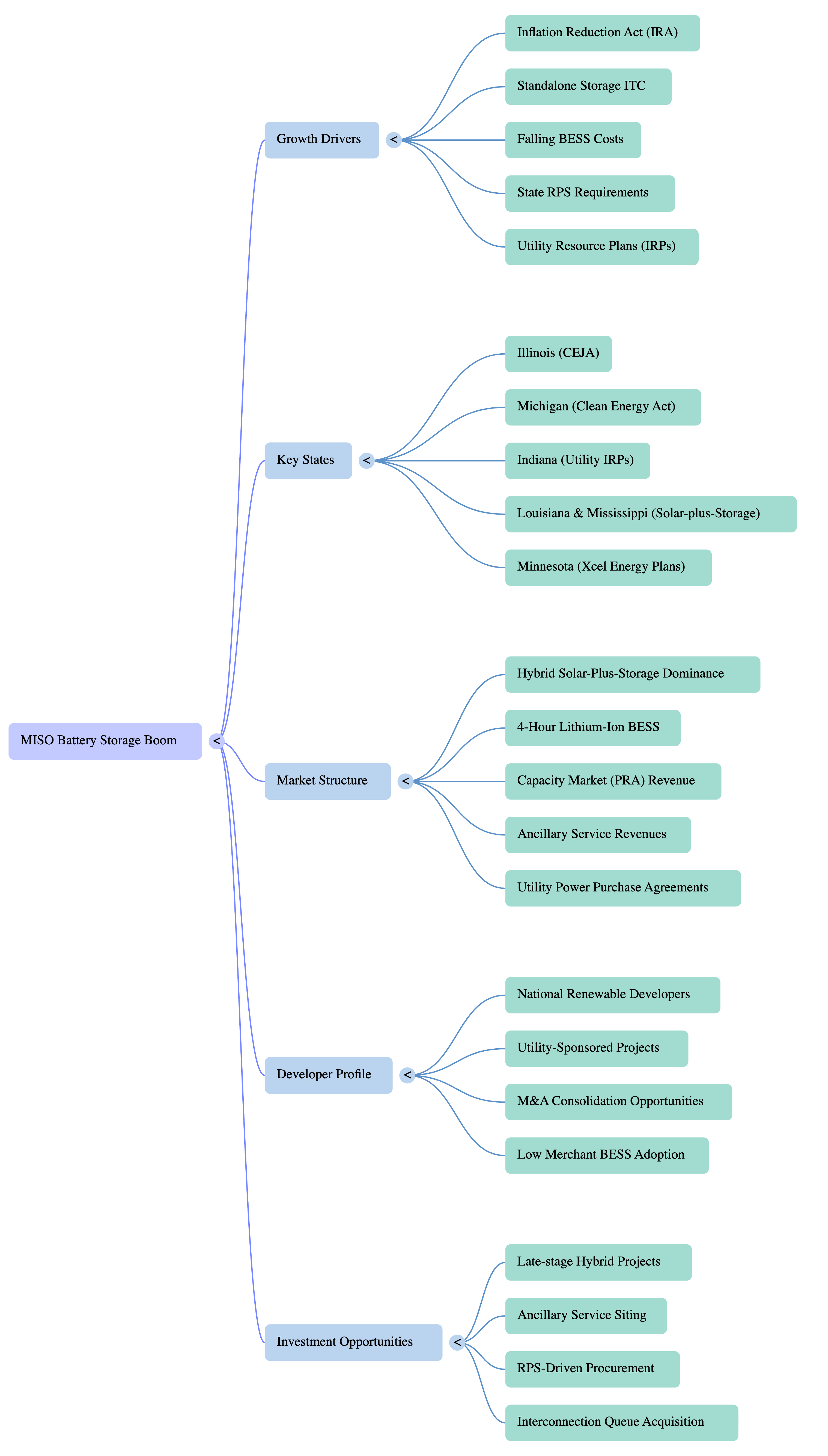
The Numbers: MISO Storage Before and After the IRA
Battery storage applications in MISO queue data show a clear inflection point around 2022–2023, coinciding with the Inflation Reduction Act's enactment in August 2022. The IRA created a standalone storage investment tax credit (ITC) for the first time, removing the prior requirement that storage be charged primarily from a co-located renewable generator to qualify for the ITC. This structural change made standalone BESS development economically viable in MISO in a way it had not been before.
| Period | MISO Storage Queue Applications | Primary Driver |
|---|---|---|
| 2018–2020 | Minimal | No standalone ITC; merchant economics weak in MISO |
| 2021–2022 | Growing | Pre-IRA ITC paired with solar; state RPS procurement |
| 2023–2024 | Significant surge | Standalone ITC, falling BESS costs, state capacity mandates |
| 2025 | Continued growth | Utility resource plans, corporate PPAs, IRA clarity |
The 4-hour lithium-ion BESS has become the dominant storage configuration in MISO applications, consistent with the national pattern. Longer-duration storage (8-hour, 100-hour) remains a small fraction of applications, concentrated in states with forward capacity market participation or specific utility resource plan requirements.
Which States Are Driving MISO Storage Growth
MISO's 15-state footprint is not uniformly active for storage development. The storage boom is concentrated in specific states with favorable economics or regulatory mandates:
- Illinois. The Climate and Equitable Jobs Act (CEJA) created significant renewable procurement requirements, including provisions for storage. Illinois utility resource plans from ComEd and Ameren have driven storage solicitations that feed into MISO queue applications.
- Michigan. Michigan's Clean Energy and Jobs Act (2023) mandated 100% clean energy by 2040 and created renewable energy portfolio standards that increased procurement of both solar and storage. DTE Energy and Consumers Energy resource plans now include significant battery storage.
- Indiana. Indiana's utility commission has approved integrated resource plans from NIPSCO and Duke Energy Indiana that include large-scale BESS, driving queue applications in the northern Indiana portion of MISO.
- Louisiana and Mississippi. The southern MISO states have seen storage applications primarily as paired solar-plus-storage projects, taking advantage of strong solar resources and the ability to claim both generation and storage ITCs on a single project.
- Minnesota. Xcel Energy's Minnesota resource plan and Great Plains Energy's procurement activities have contributed storage applications, though Minnesota's strong wind position means solar-plus-storage is competing with existing wind capacity for new procurement.
MISO Market Mechanics and Storage Economics
MISO's energy market does not create the same merchant BESS revenue stack that exists in ERCOT's energy-only market. The comparison is instructive. ERCOT has no capacity market — generators earn revenue from energy and ancillary services only, creating strong price signals for BESS to arbitrage between low-price overnight hours and high-price peak hours, especially during extreme weather events. MISO has a capacity market (the Planning Resource Auction, or PRA) that provides a capacity revenue stream but dampens the energy price volatility that makes ERCOT storage so attractive.
MISO storage economics are therefore more dependent on:
- Capacity market revenues from MISO's PRA
- Ancillary service revenues (frequency regulation, operating reserves)
- State-level capacity mandates that create bilateral procurement demand
- Co-location with solar to maximize IRA ITC capture
- Utility power purchase agreements that provide contracted revenue certainty
The merchant BESS model that works in ERCOT is more difficult to execute in MISO without contracted offtake. This means MISO storage applications are more likely to be utility-sponsored or backed by long-term PPAs than the merchant applications visible in ERCOT's queue.
Hybrid Solar-Plus-Storage: The Dominant Structure
In MISO, the dominant storage application structure is co-located solar-plus-storage rather than standalone BESS. This reflects both the IRA incentive structure (co-located storage paired with solar can claim the full ITC when charged at least 75% from the co-located generation) and the utility procurement reality — MISO utilities procuring renewable energy have increasingly required paired storage to address the intermittency problem.
The hybrid structure creates a specific developer profile. Pure-play storage developers who focus on standalone BESS are less common in MISO than developers who pair solar with storage as a combined product. National developers like NextEra, Invenergy, EDP Renewables, and Apex Clean Energy have all submitted hybrid applications in MISO, often at sites where they already hold land options for solar development.
Why This Matters for Developers and Investors
MISO's storage boom creates several distinct investment opportunities:
- Late-stage hybrid projects. Hybrid solar-plus-storage projects with MISO queue positions, state permits, and offtake letters represent the highest-value acquisition targets. The combination of a secured interconnection position and a contracted revenue stream is difficult to replicate from scratch given MISO's study timelines.
- Utility-scale standalone BESS for ancillary services. Projects positioned to provide frequency regulation and operating reserves in MISO's ancillary service market can generate strong revenues without solar co-location. These require different siting criteria (proximity to load centers) than solar-paired projects.
- State RPS-driven procurement. Illinois CEJA, Michigan Clean Energy Act, and Indiana IRP requirements will continue to drive storage procurement. Developers tracking state utility commission proceedings can identify procurement windows before they hit the broader market.
- Developer consolidation. MISO's storage application surge has attracted smaller developers who lack the balance sheet or operational experience to execute at scale. This creates M&A opportunity for larger platforms seeking to acquire permitted projects from undercapitalized developers.
Conclusion
MISO's storage boom is real, IRA-driven, and structurally different from the ERCOT or CAISO storage stories. The hybrid solar-plus-storage model dominates, state RPS requirements are the primary demand signal, and utility IRP proceedings are the key procurement pathway to watch. Developer research in MISO's storage queue requires tracking both the LLC-level applicant and the utility counterparty driving demand.
For the national storage context that frames MISO's local trend, see Battery Storage Is Flooding US Interconnection Queues. For the broader MISO solar pipeline that most storage is paired with, see Most Active Solar Developers in MISO.
Load Factor tracks MISO's full 5,545-project queue with fuel type classification, developer identification, and state-level breakdowns. Browse MISO storage projects to see the current pipeline.