One project, one chain.
The queue entry as the grid operator published it, the project company that filed it, the developer doing the work, and the parent above them.
Ownership & evidence · Load Factor Pulse
The project company exactly as filed, the developer with a confidence level, the parent only when a public record proves it, and the sources behind every link.
In the product
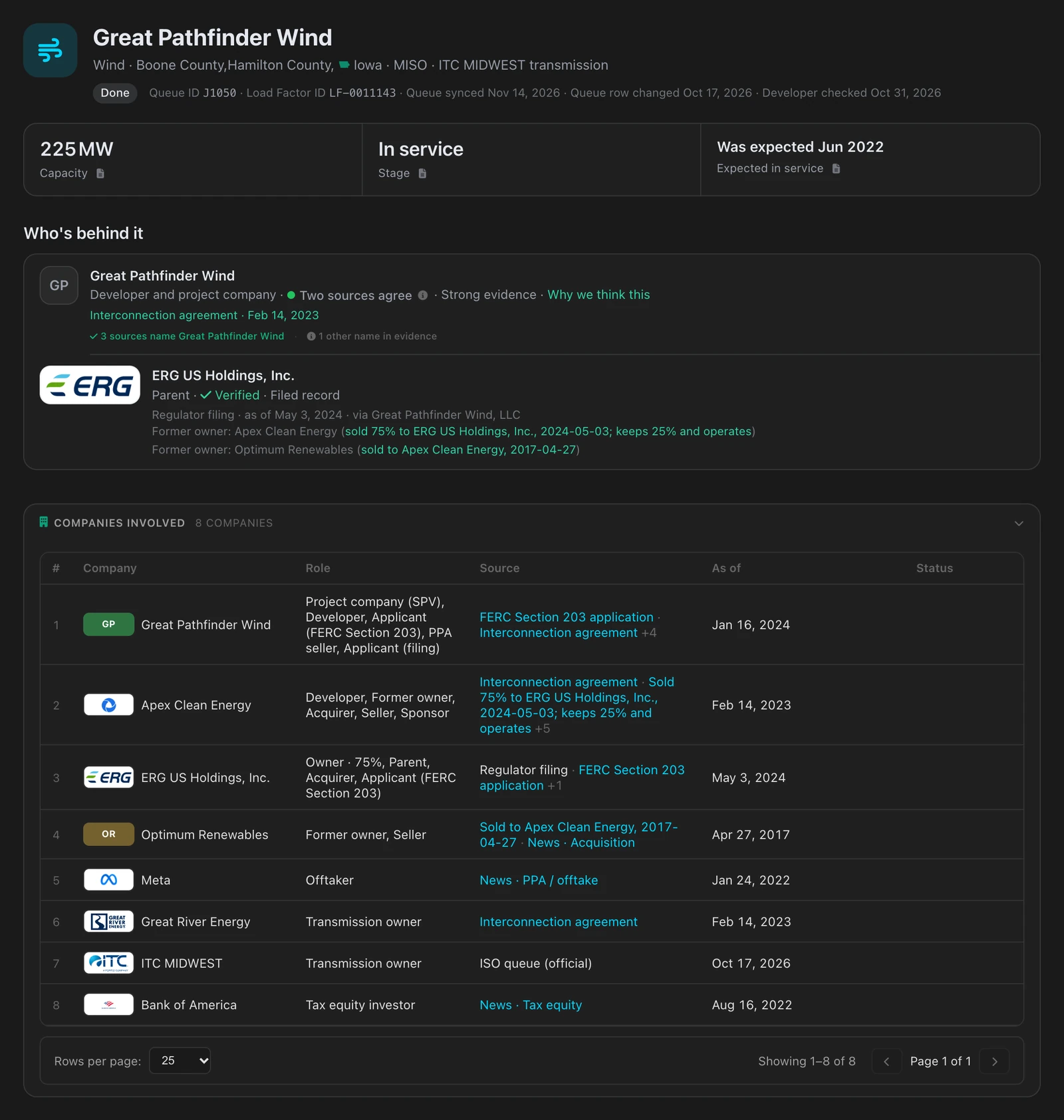
The queue entry as the grid operator published it, the project company that filed it, the developer doing the work, and the parent above them.
Spelled exactly as it appears in the filing, never tidied into a brand. Words like Solar, Wind and Storage stay in the name, because they often tell two project companies apart.
When the evidence names more than one company, the record says that too.
A parent company appears only when a public record proves it. A look-alike name or a shared address is not proof, so until a record settles it the parent stays blank.
Each link lists the public records behind it, each marked Strong, Supporting or Lead. A lead points the way and never confirms anything on its own.
The records come from grid-operator interconnection queues, federal filings (FERC, SEC and EIA), corporate disclosures, state and local public records, plant and market data, news and announcements, and many more.
Tracking a competitor? See every project it is building across all of its project companies, with its deals and the buyers of its power. Competitor intelligence
A developer shows Two sources agree only when two or more independent primary sources name it. A developer named only by the grid operator's queue shows Named in the queue, one named by another single source is inferred, and a project with nothing on file shows Not identified.
Because the filed name is what matches other records. Words like Solar, Wind and Storage stay in the name, since they are often the only thing that tells two project companies apart.
Only when a public record proves it. A look-alike name or a shared address is not proof, so the parent stays blank until a record settles it.
Public records only: grid-operator interconnection queues, federal filings (FERC, SEC, EIA), corporate disclosures, state and local public records, plant and market data, news and announcements, and many more. Each link lists the records behind it.
More in Load Factor
A walkthrough of the projects, developers and evidence in the markets you work in.
Queue movement, newly identified developers and the week’s deals, every Monday. Read past issues